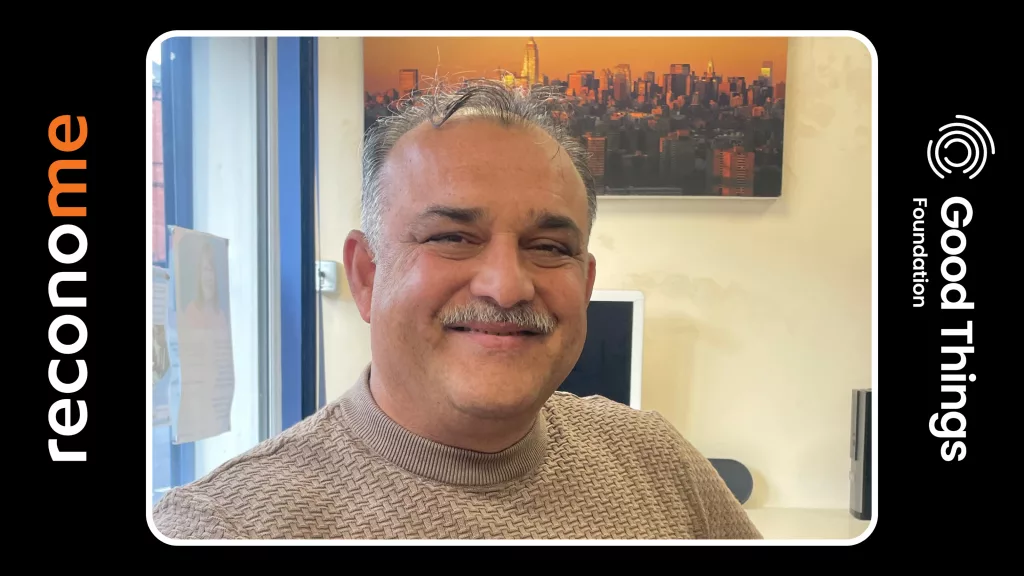
A phone that sat forgotten in an office drawer is helping Ahmed learn English – bridging the gap between isolation and a brighter future in the UK. This is his story.
Arriving in the UK and facing digital exclusion
When Ahmed arrived in England from Afghanistan in 2021, he faced the daunting challenge of starting over. Despite having worked with the British military, his inability to speak English made joining society feel impossible for him and his family.
Without the language and without access to technology, Ahmed felt excluded from the digital world. For someone living with a back injury and chronic pain, having a device at home was vital.
The scale of the digital divide in the UK
Ahmed’s situation reflects a wider pattern of digital exclusion across the UK. According to Good Things Foundation’s Digital Nation 2025 data, 7.9 million people in the UK lack basic digital skills, while 1.6 million adults do not have access to a smartphone, tablet or laptop. As more of daily life moves online, those without access to technology are increasingly excluded from essential services, education, employment opportunities and community support.
A refurbished device from the National Device Bank
Ahmed found his way to Learn for Life, a member of Good Things Foundation’s National Digital Inclusion Network. The hub provided him with a smartphone, data, and the digital skills support needed to navigate his new home.
The devices distributed through the National Device Bank are made possible by organisations that choose to repurpose their surplus IT responsibly through Reconome, Good Things Foundation’s exclusive technology partner. Each device is given a second life and redirected to the people who need them most, creating a direct link between our partners and the lives that are transformed.
For Ahmed, having a device at home allows him to study English, use educational apps, and stay connected. He can now even use AI to help him draft professional emails when communication feels particularly difficult.
“At that time, I couldn’t speak English like this. The device was very good for me because in my free time, I can solve my problems with English grammar. I find English courses in the apps and use YouTube to learn.”
– Ahmed
The real-world impact of digital inclusion
Speaking about Learn for Life, Ahmed said: “Here, I find respect and kindness; I feel safe and happy. If you want to live in the UK, you have to improve your language to find a job and join society. Learn for Life is a safe place where you can find a good future.”
What began with a single refurbished smartphone from the National Device Bank has given Ahmed the tools to learn English, stay connected, and work towards the future he wants to build in the UK.
Turning old tech into someone’s new beginning:
Ahmed’s story illustrates what sits at the heart of Reconome’s partnership with Good Things Foundation: surplus IT, handled responsibly, has the power to do far more than reduce e-waste. At the core of the partnership is Reconome’s commitment to deliver 85,000 refurbished devices to digitally excluded people across the UK by June 2029.
When organisations choose Reconome to manage their IT asset disposition, their surplus devices don’t simply avoid landfill, they enter a pipeline that delivers measurable social impact. This is what responsible ITAD looks like in practice. Not just secure data destruction and environmental compliance, but a commitment to ensuring that technology continues to serve people long after it leaves your estate.
Your surplus IT can change someone’s life
Every device that passes through Reconome has the potential to deliver real, lasting social impact, alongside the environmental and compliance outcomes your organisation already expects from ITAD.
Your old tech can power someone’s new beginning. Talk to our team: rethink@recono.me.