
DSP partners with Reconome to deliver significant social impact by empowering the work of their charity partner with repurposed IT.
The challenge
DSP, a rapidly growing enterprise database management specialist, shared with Reconome a commitment to delivering true and measurable social impact from the disposition of their surplus technology. The aim? To support and empower their charity partner, Project Harar, to better serve and treat vulnerable young patients with cleft lip and palate conditions in Ethiopia.
This partnership demonstrated how tangible change can be achieved in remote locations across the globe, from DSP’s head office in London. All that is required is the desire, the devices, and the right partner.
What we did
- Step 1 – Devices in: The project kicked off with the seamless collection, assessment and refurbishment or recycling of DSP’s devices. With industry-leading data deletion and security measures in place, this process focuses on lifecycle extension, maximising reuse and keeping components out of landfill.
- Step 2 – Understanding charity requirements: It was crucial to appreciate the needs of the charity through close collaboration, so that we could equip them with the devices necessary to deliver their vital services in Ethiopia: enabling access to essential medical treatment.
- Step 3 – Making the difference: Reconome generated proceeds from DSP’s reusable equipment to directly fund the bespoke range of devices essential to supporting Project Harar’s work on the ground in Ethiopia.
- Step 4 – Measurable outcomes: Reconome provided DSP with comprehensive reporting of environmental outcomes from repurposing their surplus IT devices across multiple sites, equipping their team with the evidence to proudly showcase what the project achieved.
The results
Social impact
Reconome worked with Project Harar to provide a much-needed, access-boosting tech toolkit, by establishing what technology would have the greatest impact in supporting their work and providing the connectivity to maximise device usability:
- Tablets provided care workers the ability to capture and record patient data during home visits.
- Laptops with a high spec, as well as printers, were donated to help digitise financial processes and crucial operational tasks.
- Connectivity: high powered MiFi devices (dongles), enabling the team to connect to 5G in different, remote locations as needed, even where internet connectivity is weak.
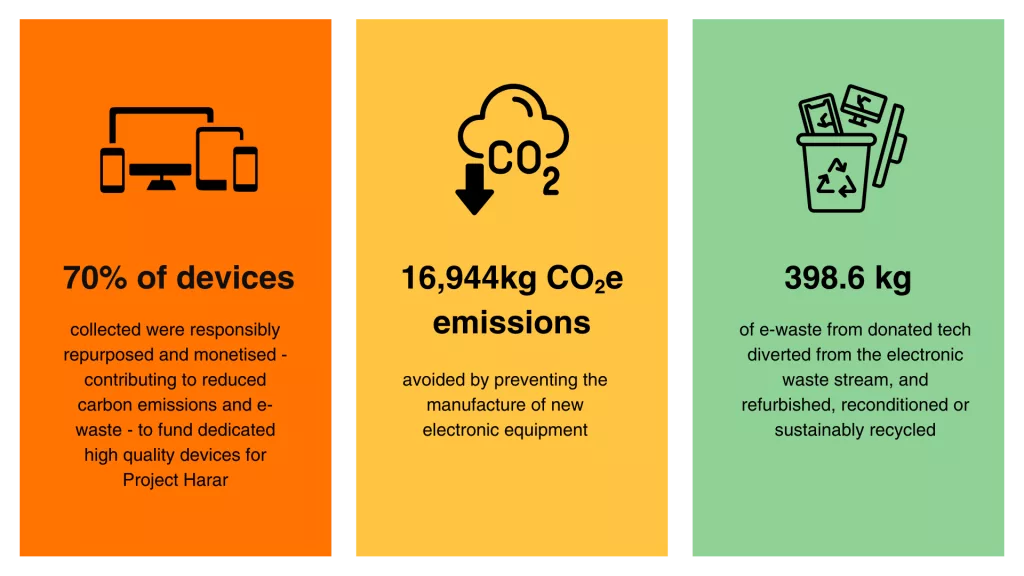
Environmental impact
“The donated equipment, particularly laptops and dongles to access the 5G network, has been transformational. Previously, the team was trying to deliver support for families while working on old devices with poor connectivity. The technology we’ve been given has meant the team can do things that we would often take for granted. They are now able to consistently serve vulnerable members of rural communities to raise awareness about treatments available for cleft conditions, and then enable them to access those treatments.
During our recent complex surgical programme, the iPhones donated to us were incredibly useful for connecting the team, and were used by the surgeons to record medical photos and videos and to share them easily with the wider Project Harar team. In addition to this, the UK medical team is able to stay in close contact with the Ethiopian medical team and coordinate patient care across multiple hospitals.”
– Jackie Riley, CEO, Project Harar
This partnership shows what’s possible when surplus tech is treated not as waste, but as opportunity. With a clear mission, the right partner, and a willingness to act – businesses can power social change, one device at a time.
If you would like to learn more about how you could deliver environmental and social impact with Reconome, contact rethink@recono.me.