
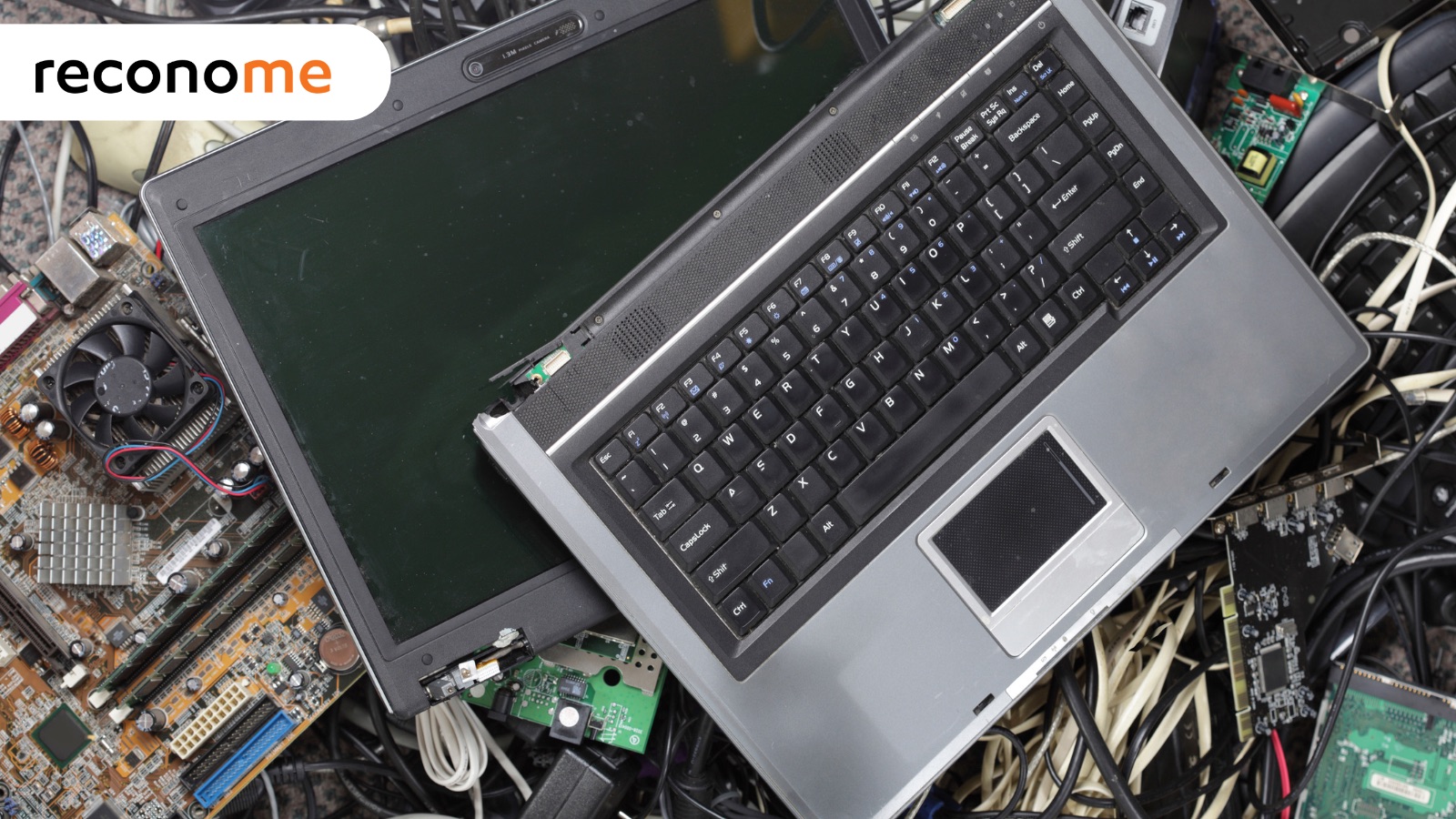
A Third of the Laptops You Destroy Still Work
· 4 min read
Blancco found 35% of laptops and desktops destroyed by large organisations were still working. The shredder is solving a proof problem.
· 3 min read · Written by Bobby Ghayouri.

The UK is one of the worst producers of electronic waste per person on the planet. That is usually framed as a household issue, the drawer full of old phones, the cupboard of dead cables. But the biggest single source of avoidable e-waste in most organisations is not in anyone’s kitchen. It is in the IT store cupboard.
For any business of scale, IT hardware is where the greatest e-waste risk and the greatest opportunity both sit. Get disposition wrong and you are looking at data-breach exposure, compliance failures and reputational damage. Get it right and the same pile of retired kit becomes carbon saved, money recovered and lives changed. Here is how to think about it.
Globally, only around a fifth of e-waste is documented as properly collected and recycled. The rest leaks out of the formal system, and a disturbing amount is shipped to lower-income countries and burned to strip out the metals, poisoning whole communities in the process. That is the reality behind "we sent it off to be recycled." Unless you know exactly where a device ended up, "recycled" is a hope, not a fact.
Compliance. The WEEE regulations place real obligations on how electrical and electronic equipment is disposed of. Boards are expected to understand them, not delegate them into a blind spot.
Data. A retired laptop is a data breach waiting to happen, and it is the single biggest anxiety for most IT and infosec leaders. Disposition without a verifiable chain of custody and certified erasure is not disposition; it is risk transfer. Done properly, every data-bearing device is wiped to NIST 800-88 and IEEE 2883-2022 standards, with a certificate for every unit and physical destruction only where a drive genuinely cannot be sanitised.
Reputation and Scope 3. Customers, employees and investors now expect credible environmental credentials as standard. How you handle end-of-life IT is a visible, measurable line in your Scope 3 and ESG reporting, and increasingly one you will be asked to evidence.
A responsible process is simple to describe and hard to do well:
One principle sits underneath all of it: reuse before recycling. Recycling shreds a working machine to recover a fraction of its materials, when research by The Restart Project found that almost half of the electricals sent for recycling could have been reused instead. (We make the full carbon and ESG case for that in our reuse-first article.)
Handled properly, retired IT stops being a liability and becomes one of the easiest strategic wins a business has: risk removed, carbon avoided, value recovered, and genuine social impact you can put your name to. When we ran this for the Metropolitan Police, the output was not a vague pledge. It was 21,425 devices wiped, 16,243kg of e-waste prevented and 2.7 kilotonnes of CO2 avoided, supporting vulnerable people across 32 London boroughs.
If you are refreshing your estate this year, talk to us about where the old kit goes next.
Old tech. New beginning.
More insights
· 4 min read
Blancco found 35% of laptops and desktops destroyed by large organisations were still working. The shredder is solving a proof problem.
· 4 min read
Every retired device has several possible futures. Here is how we now choose the best one, and why it matters for device reuse.
· 3 min read
Anyone can say their IT disposal is sustainable. Here is how to measure what your retired tech actually achieves, and how to prove it.
Let’s discuss how your surplus technology can drive positive change.